In a compact optical module, a thermal interface material must transfer heat effectively while remaining compatible with the surrounding assembly. For manufacturers working with silicone-sensitive components, oil bleed and surface contamination can become additional reliability concerns.
KLEBER supported an optical-module manufacturer in addressing a thermal interface problem using Flextein® S22001, a silicone-free thermal gap pad. According to KLEBER, the solution was evaluated through third-party testing and customer application trials and resolved the customer’s application issue.
This article explains the engineering considerations behind that material choice and the checks that matter when evaluating a similar interface.
The Application Challenge: Heat Transfer in a Sensitive Assembly
An optical-module DSP requires an effective thermal path to the module’s heat-dissipating structure. The interface must accommodate the assembly gap and maintain suitable contact between mating surfaces.
Sustained operating temperatures and repeated temperature changes make long-term interface behavior an important selection consideration. Where optical components are nearby, engineers must also consider whether mobile or volatile material constituents could reach sensitive surfaces.
For a manufacturer evaluating a replacement material, these requirements create a combined challenge: support heat transfer, fit the mechanical design and address silicone sensitivity within the module.
The KLEBER customer project focused on an optical-module application and used Flextein® S22001 as the material solution.
A Typical Risk: Oil Bleed and Surface Contamination
One potential concern with certain silicone-based thermal interface formulations is oil bleed—the separation or movement of mobile constituents from the material.
In a confined assembly, oil bleed may leave residue around the original contact area. Depending on the formulation and exposure conditions, changes in material condition or contact can also become relevant to thermal performance. Separately, volatile constituents may deposit on nearby surfaces, creating a concern for sensitive optical assemblies.
These are possible failure mechanisms to investigate. Their presence and severity depend on the material, temperature, assembly conditions and exposure duration.
A useful engineering assessment therefore distinguishes among:
- Oil bleed or residue around the interface.
- Changes in the material’s mechanical condition.
- Displacement or loss of contact with mating surfaces.
- Deposition on nearby sensitive components.
- Changes in measured thermal performance.
Identifying the actual mechanism helps define what a replacement material must achieve.
The Material Choice: Flextein® S22001
For this project, KLEBER’s solution used Flextein® S22001, a silicone-free thermally conductive sheet intended for silicone-sensitive applications.
The supplied English technical data sheet lists the following typical properties:
| Property | Flextein® S22001 |
|---|---|
| Thermal conductivity | 22.0 W/m·K |
| Available thickness | 0.5–4.0 mm |
| Hardness | Shore OO 40 |
| Service-temperature range | −40°C to +125°C |
| Standard sheet size | 230 × 230 mm |
| Surface characteristic | Natural tack on both sides |
Source: Flextein® S22001 English TDS, revision A1.0. Download the English TDS (PDF).
Sheet and die-cut configurations are available. Adhesive backing or PI film can be discussed where the assembly requires them.
The silicone-free formulation addresses a material-composition requirement. Its suitability for a particular module still depends on the complete interface, including thickness, compression, contact area and operating conditions.
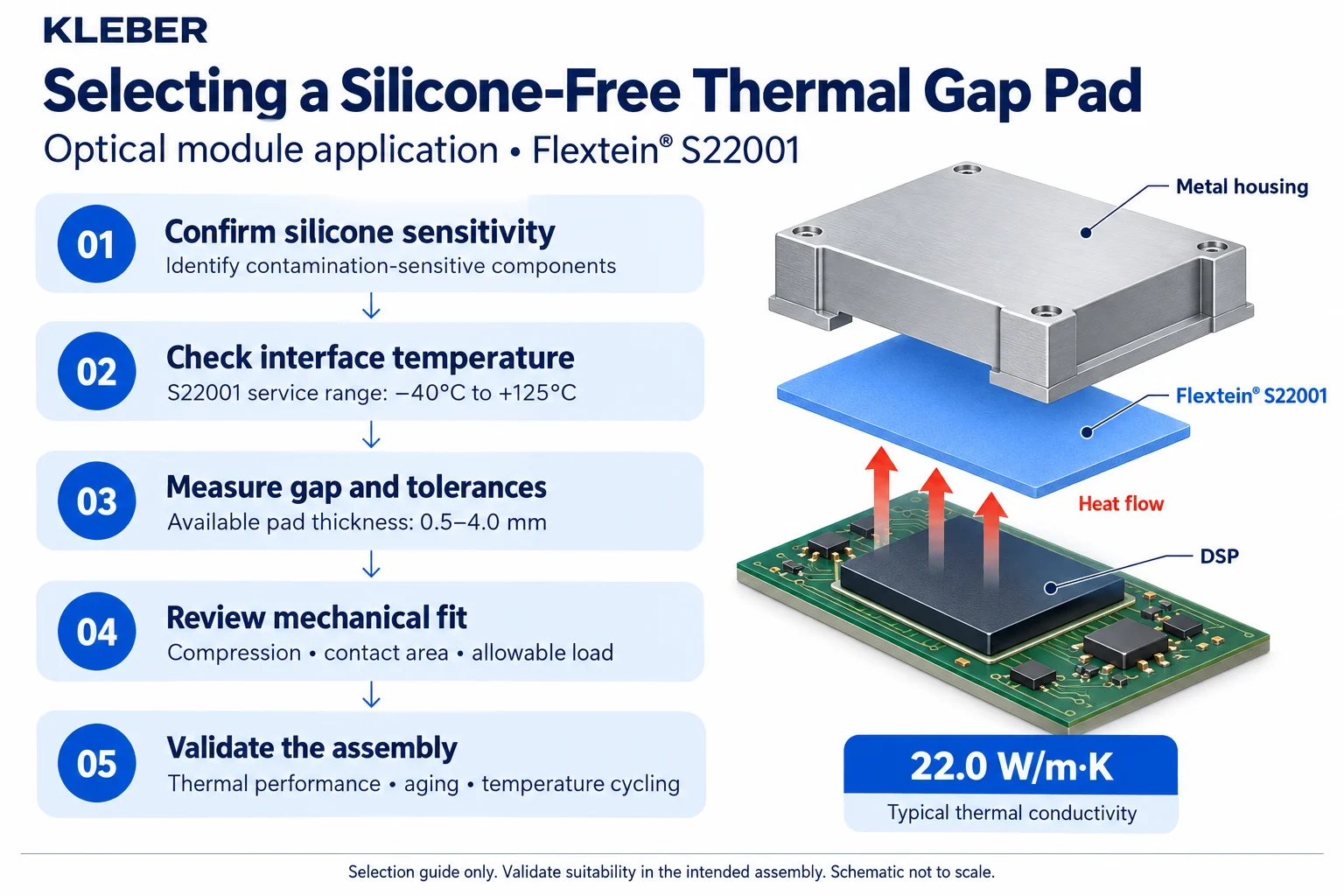
Why the Interface Design Still Matters
A conductivity value provides useful information for shortlisting materials, but the assembled interface determines the thermal path.
For an optical-module manufacturer considering S22001, the first review should establish the minimum and maximum gap between mating surfaces. The selected thickness must accommodate that variation while staying within the assembly’s allowable mechanical loading.
Contact area and surface geometry also need attention. A pad that fits the nominal drawing may require further evaluation when component heights, housing dimensions and assembly tolerances vary.
Natural tack on both sides can assist placement during assembly. The final evaluation should nevertheless confirm that the material remains correctly positioned through the intended manufacturing and operating sequence.
The documented service-temperature range also needs to be checked against the expected interface temperature. A temperature rating alone does not establish lifetime performance or qualification under a specific cycling profile.
Verification Through Third-Party Testing and Customer Trials
KLEBER reports that the S22001 solution was evaluated through third-party testing and customer application trials, and that it resolved the customer’s thermal interface issue.
The test methods, exposure conditions and numerical results are not included in this public account. The outcome should therefore be understood as a qualitative report of this customer project.
For manufacturers evaluating a similar change, a validation plan should connect the original concern to measurable acceptance criteria. Relevant checks may include initial thermal performance, material condition after temperature exposure, interface coverage and inspection of nearby sensitive surfaces.
Customer trials should also use the intended assembly configuration. This helps assess how the candidate material behaves with the actual gap, fastening arrangement and heat-dissipation structure.
The appropriate test temperatures, durations and cycle counts should be agreed for the application.
What Other Optical-Module Manufacturers Can Take from This Case
The project illustrates the value of including silicone sensitivity in thermal interface selection from the beginning.
For a new evaluation, provide the material supplier with the interface dimensions, expected temperature profile, allowable loading and the specific concern being addressed. Where oil bleed or surface contamination is suspected, photographs and inspection records can help define the investigation.
A replacement should then be assessed against both thermal and assembly requirements, with acceptance criteria established before qualification begins.
Frequently Asked Questions
Does silicone-free mean zero outgassing or oil bleed?
The designation alone does not establish either claim. Relevant testing is needed for the intended environment.
Can S22001 replace an existing pad at the same thickness?
The existing gap, compression and allowable loading should be reviewed before selecting a replacement thickness.
Does this customer outcome establish suitability for every optical module?
Each module design requires its own evaluation. This project provides an application example rather than a universal qualification.
DISCUSS YOUR APPLICATION
Discuss Your Optical-Module Application with KLEBER
If your team is reviewing a silicone-sensitive thermal interface, share the module’s gap dimensions, temperature profile, current material and observed concerns with KLEBER’s application engineers.